ISLAMABAD: The Islamabad High Court (IHC) on Monday directed provincial governments to prevent the use of official resources and state machinery for political rallies and processions, while disposing of a petition concerning the Pakistan Tehreek-e-Insaf’s (PTI) planned march to Islamabad on September 27.
A three-member bench led by Justice Sardar Muhammad Sarfraz Dogar issued the directions after hearing arguments from the Islamabad administration, government representatives and the petitioner’s counsel.
In its ruling, the court ordered chief ministers to ensure that government vehicles, machinery, funds and other official resources were not deployed for marches, rallies or demonstrations.
The court further made it clear that government employees could not be compelled to participate in political protests.
At the same time, the IHC directed provincial governments, the Islamabad administration and other relevant authorities to safeguard citizens’ constitutional rights during protests and political gatherings.
The court observed that no political party or leader possessed a legal right to occupy roads, highways or other public spaces in a manner that disrupted public life. It also directed the Islamabad administration and Ministry of Interior to ensure that citizens’ freedom of movement was not impeded.
Directions were also issued to the federal secretary interior, Islamabad chief commissioner and inspector general of police.
The PTI has announced a nationwide protest campaign culminating in a march towards the federal capital on September 27, with the party demanding the release of its founder, Imran Khan, who remains incarcerated.
Government raises concerns over past PTI protests
During the hearing, the Islamabad attorney general argued that previous PTI marches had involved the use of government machinery and questioned whether the proposed demonstration could be guaranteed to remain peaceful.
The law officer referred to statements by PTI leaders describing the march in terms of “freedom or martyrdom” and requested permission to present video footage of the party’s November 2024 protest.
Although the chief justice initially remarked that showing videos in court was not customary, Justice Dogar subsequently permitted the footage to be played.
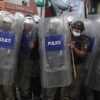
The court was shown videos depicting police preparations, alleged attacks on law enforcement personnel, removal of security containers, fires at D-Chowk and the Green Belt, damage to public property and images of police personnel killed during the protests.
Footage of a vehicle allegedly running over Rangers personnel was also presented.
The attorney general argued that the scenes were inconsistent with the PTI’s claim that its demonstrations would remain peaceful.
He maintained that while citizens had fundamental rights to assemble and express themselves, those rights were subject to reasonable restrictions in the interests of public order and national security.
According to the government’s counsel, anyone intending to stage a protest or march in Islamabad must seek permission from the relevant magistrate and submit details of the planned event, including security arrangements.
He said the district magistrate could refuse permission if adequate security measures were not assured.
The law officer also defended the placement of security containers in the capital, saying the federal government had the authority to designate areas of Islamabad as a Red Zone.
He stressed that the government was not opposed to political parties holding demonstrations, provided they complied with the law.
Petitioner highlights possible disruption
The attorney general also challenged the PTI’s demands for Imran Khan’s release and the removal of the government, describing the demands as legally impermissible.
He said the appropriate legal route for securing the release of a convicted prisoner was through the courts.
During the proceedings, Justice Dogar also questioned whether government representatives could make statements capable of provoking the public.
The attorney general responded that no government official had the right to incite citizens and that such conduct could not be justified as freedom of expression.
The petitioner’s counsel, meanwhile, argued that authorities should not wait for violence or property damage before taking preventive measures. He referred to claims that millions of people could converge on Islamabad and expressed concern over the potential disruption to residents and businesses in the capital.
The counsel also alleged that the conduct of Khyber Pakhtunkhwa Chief Minister Sohail Afridi was affecting the discharge of his official responsibilities.
After hearing arguments from all sides, the bench reserved its decision and later issued directions governing the use of state resources and protection of citizens’ rights during political protests.