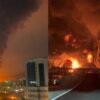
WASHINGTON: U.S. President Donald Trump said he is not considering negotiations with Iran and suggested the ongoing conflict could conclude only if Tehran’s military structure and leadership are completely dismantled.
Speaking to reporters aboard Air Force One on Saturday, Trump indicated that the ongoing air campaign could make diplomacy irrelevant if Iran’s military is destroyed and its remaining leadership is eliminated.
“At some stage there might be no one left to even declare surrender,” Trump said.
Iran president’s remarks trigger domestic criticism
Meanwhile, fighting between Israel and Iran continued as the U.S.-Israeli military campaign entered its second week. Iranian President Masoud Pezeshkian apologized to neighboring countries affected by Iran’s retaliatory strikes on U.S. military facilities located in their territories.
“I personally apologize to neighboring states impacted by Iran’s actions,” Pezeshkian said, urging Gulf countries not to join U.S. and Israeli attacks against Iran.
However, his remarks sparked backlash from hardliners within Iran. Pezeshkian rejected Trump’s demand for unconditional surrender, calling it unrealistic, but said Iran’s temporary leadership council had agreed to halt attacks on neighboring countries unless strikes against Iran originated from their soil.
Israeli Prime Minister Benjamin Netanyahu, speaking in a televised address, said members of the Islamic Revolutionary Guard Corps who laid down their weapons would not be harmed.
Iranian security official Ali Larijani dismissed speculation of divisions within Iran’s leadership, stating there was unity among officials regarding the country’s war strategy.
Explosion near U.S. embassy in Norway
Separately, an explosion occurred near the Embassy of the United States, Oslo early Sunday, causing minor damage but no injuries, according to Norwegian authorities. Witnesses reported smoke rising around the embassy compound, though the cause of the blast remained unclear.
Gulf tensions rise
Sources told Reuters that Saudi Arabia warned Tehran that continued attacks on its territory or energy facilities could prompt a direct response. Saudi defense officials also said they intercepted a drone targeting the diplomatic district in Riyadh, with no casualties reported.
Iran’s president later repeated his statement on social media but omitted the apology that had angered hardline factions, including members of the Revolutionary Guards.
Iran’s judiciary chief, Gholam-Hossein Mohseni-Ejei, said some regional countries were allowing their territory to be used for attacks against Iran and warned that retaliatory strikes would continue.
Shortly afterward, the Revolutionary Guards claimed their drones struck a U.S. air combat facility near Abu Dhabi in the United Arab Emirates, though Reuters could not independently confirm the claim.
Regional conflict widens
Iranian state media also reported strikes against U.S. forces stationed in Bahrain, while explosions were heard in Doha.
Meanwhile, Israel warned Lebanon it would face severe consequences if authorities failed to curb attacks by the Iran-backed militant group Hezbollah. Israeli airstrikes targeted Hezbollah positions, including areas in southern Beirut.
Lebanon’s health ministry said Israeli strikes since Monday have killed about 300 people, including civilians after an apartment in the Ramada hotel building in central Beirut was hit.
Rising casualties and economic impact
According to Iran’s ambassador to the United Nations, Amir Saeid Iravani, U.S. and Israeli strikes have killed over 1,300 Iranian civilians and injured thousands. Iranian attacks have killed 10 people in Israel, while six U.S. service members have also died in the conflict.
The widening war has disrupted global markets and pushed energy prices higher. Oil production cuts have already begun in countries including Kuwait, Iraq, and Qatar.
With the vital shipping route through the Strait of Hormuz effectively closed, oil prices have surged to multi-year highs, raising concerns about global economic fallout.
Meanwhile, Iranian media reported that influential clerics are pushing for the swift selection of a new supreme leader, with key meetings expected to take place soon.