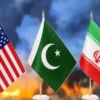
WASHINGTON: The United States launched targeted strikes against missile installation sites and boats attempting to lay mines in southern Iran on Monday, according to US Central Command. These military actions threaten to undermine a fragile ceasefire and cast doubt on prospects for a diplomatic resolution to the ongoing Middle East conflict.
The military operations coincided with Iranian negotiators arriving in Doha for fresh talks aimed at ending months of hostilities, while Israel intensified its military activities against Iran-backed Hezbollah in southern Lebanon.
Following the strikes, oil markets experienced volatility, with concerns rising over potential disruptions to the strategic Strait of Hormuz, a vital chokepoint for global energy supplies. Iran’s blockade of the strait has already impacted worldwide fuel markets.
Tim Hawkins, a spokesperson for US Central Command, stated, “US forces carried out self-defense strikes in southern Iran today to safeguard our personnel from threats posed by Iranian forces.” No specifics about the targets or the extent of the strikes were provided, only that they involved missile launch sites and vessels suspected of mine-laying.
Despite these military actions, Secretary of State Marco Rubio expressed optimism about reaching an agreement, emphasizing the importance of the Strait of Hormuz. “Discussions are ongoing in Qatar, and we’re working through the details of the initial draft. It may take a few days,” Rubio said during a visit to India, without addressing the immediate impact of the recent strikes.
Rubio also reaffirmed that the Strait remains open, condemning any attempts to unlawfully restrict it. “What’s happening there is illegal and unacceptable,” he added.
Meanwhile, Iran’s state broadcaster IRIB reported hearing multiple loud explosions near Bandar Abbas around midnight local time (2030 GMT). Authorities are investigating the cause, with the situation described as normal in the southern port city.
The US strikes threaten to derail a ceasefire that began in April, as tensions persist between Washington and Tehran amid stalled negotiations to end the conflict, which has severely disrupted global energy markets.
Oil prices reacted with fluctuations on Tuesday morning, with West Texas Intermediate dropping more than five percent but remaining below $100 per barrel, while Brent crude saw slight increases.
The possibility of a peace agreement diminished further when Israeli Prime Minister Benjamin Netanyahu vowed to “crush” Hezbollah in Lebanon. Iran has insisted that any peace deal must also address the conflict in Lebanon.
In related developments, former President Donald Trump suggested via social media that Iran should transfer its enriched uranium to the US for destruction or have it destroyed within Iran with independent oversight. Trump indicated that this could be part of a broader agreement, though the details remain unclear, especially since the Atomic Energy Commission was dissolved in 1974.
Earlier in the day, Trump called for regional countries—such as Saudi Arabia, the UAE, Qatar, Pakistan, Egypt, Turkey, Bahrain, and Jordan—to join the Abraham Accords, a peace initiative initiated in 2020 that normalized relations between Israel and several Arab states. He claimed to have discussed these efforts with regional leaders over the weekend.
While the Abraham Accords have been welcomed by some, significant opposition remains in parts of the Middle East due to unresolved Israeli-Palestinian issues. Gulf nations like Saudi Arabia and Qatar have emphasized that normalization with Israel is contingent on the establishment of a Palestinian state.
Analysts from the Arab Gulf States Institute in Washington, like Anna Jacobs, remarked that Gulf nations are unlikely to accept Trump’s maximalist demands. “The security of Gulf countries is at greater risk than ever due to reckless US policies, and they are unlikely to normalize relations with Israel under current circumstances,” she said.
Prior to the recent Iran strikes, Rubio had suggested that a deal might be reached by Monday. However, Iran’s foreign ministry spokesman Esmaeil Baqaei indicated that while negotiations had progressed on many issues, a formal agreement was not yet imminent.
Israeli Prime Minister Netanyahu announced an acceleration of military operations in Lebanon following drone attacks by Hezbollah on Israeli forces. He emphasized that any final agreement with Iran must fully eliminate its nuclear threat, a stance strongly supported by Washington.
Iranian officials have reiterated that, despite US demands to cease uranium enrichment, discussions regarding Iran’s nuclear program have been postponed until after initial agreements are reached.