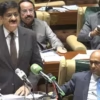
KARACHI: The Sindh government has allocated over Rs108 billion in its FY2026-27 budget for comprehensive development projects in Karachi, emphasizing transportation, water, sanitation, education, and civic infrastructure, according to Chief Minister Syed Murad Ali Shah. He highlighted that the city’s development plan includes a total of 816 projects with an estimated expenditure of Rs644.3 billion, of which 167 major projects costing more than Rs500 million are already underway, along with 110 mega projects valued above Rs1 billion.
The budget allocates Rs108.1 billion across 822 schemes specifically for Karachi, with Rs100.19 billion earmarked for the city during the upcoming financial year. A significant portion of the investment focuses on improving traffic flow and road infrastructure, including the construction of new flyovers, underpasses, and interchanges. Notable projects include a flyover from Star Gate on Airport Road at Rs1.2 billion, a Rs1.5 billion right-turn underpass from Malir Halt to Shahrah-e-Faisal, and additional infrastructure at key junctions such as Gujjar Nala, Bhutto Highway, and Shah Faisal Road.
In terms of water and drainage, the government has committed over Rs3 billion to stormwater drainage and sewerage enhancement, including phases of major storm drain construction, rehabilitation projects, and the K-4 Water Supply Project. The Karachi Water and Sewerage Services Improvement Project (KWSSIP) Phase-II and the Greater Karachi Sewerage Plan S-III are also ongoing, with substantial funds allocated for upgrading water infrastructure and reducing leakages.
Solid waste management has received a boost with over Rs9 billion allocated for the Solid Waste Emergency and Efficiency Programme, which includes new garbage transfer stations and landfill site upgrades. The city’s public transportation infrastructure is also set for expansion, with Rs13.2 billion for the Karachi Red Line BRT project and Rs3.5 billion for the Yellow Line corridor, alongside investments in the Karachi Safe City initiative and forensic science facilities.
Health and education sectors will see increased funding, including Rs1 billion for the Sindh Infectious Diseases Hospital, Rs1.4 billion for pediatric cardiology at NICVD, and development of new medical colleges and universities. Additionally, funds are allocated for infrastructure improvements in civic governance, markets, sports facilities, and youth programs.
Further schemes include Rs4.37 billion for the Lyari Transformation Package, along with projects for the rehabilitation of neighborhoods affected by nullah projects, ongoing road repairs across districts, and urban greening initiatives such as street lighting and plantation drives. Murad Ali Shah reaffirmed that prioritizing transport, water, and drainage remains central to enhancing urban living standards and supporting Karachi’s growth as Pakistan’s largest city.