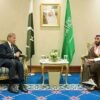
WEB DESK: Deputy Prime Minister and Foreign Minister Ishaq Dar on Thursday urged the international community and the ASEAN Regional Forum (ARF) to play a more active role in addressing long-standing regional conflicts, saying unresolved disputes such as Jammu and Kashmir and rising tensions over the Indus Waters Treaty continue to undermine peace in South Asia.
Speaking at the 33rd ASEAN Regional Forum Ministerial Meeting, Dar outlined a range of security challenges confronting the world, including instability in South Asia, the Gulf crisis, the humanitarian situation in Gaza, terrorism, Afghanistan, Ukraine, the South China Sea, and climate change.
He said the unresolved Kashmir dispute remained a major source of tension between Pakistan and India, reiterating Pakistan’s support for a peaceful settlement in line with the UN Charter, relevant Security Council resolutions, and the wishes of the Kashmiri people.
Referring to India’s decision to suspend implementation of the Indus Waters Treaty, Dar described the move as a violation of international obligations, warning that using water as a political tool could endanger the livelihoods of nearly 250 million Pakistanis.
He called on ARF member states and the wider international community to oppose unilateral actions that undermine international law and regional stability.
Discussing developments in the Gulf, Dar stressed that ongoing tensions have consequences far beyond the region. He highlighted Pakistan’s diplomatic engagement aimed at reducing tensions, including efforts that helped facilitate a ceasefire and leadership-level dialogue resulting in the Islamabad Memorandum of Understanding.
He thanked the United States, Iran, Gulf countries, and other international partners for their confidence in Pakistan’s mediation efforts and urged all sides to honour their commitments, exercise restraint, reopen the Strait of Hormuz, and restore uninterrupted international maritime trade.
On the humanitarian crisis in Gaza, Dar condemned the continuing violence and reaffirmed Pakistan’s longstanding support for the establishment of an independent and sovereign Palestinian state based on the pre-1967 borders, with Al-Quds Al-Sharif as its capital.
Addressing terrorism, the foreign minister said Pakistan had paid a heavy price in the fight against militancy, with more than 90,000 lives lost and economic losses exceeding $150 billion. He urged Afghanistan’s interim authorities to prevent terrorist organisations, including the Tehreek-e-Taliban Pakistan (TTP), also referred to by Pakistan as Fitna Al-Khawarij, from using Afghan territory to launch attacks against neighbouring countries.
Dar said meaningful action against terrorism would pave the way for stronger regional connectivity and expanded trade between South and Central Asia.
He also reiterated Pakistan’s support for dialogue-based solutions to the conflicts in Ukraine and the South China Sea while reaffirming Islamabad’s commitment to the One-China policy.
Highlighting climate change, Dar noted that Pakistan contributes less than one per cent of global greenhouse gas emissions but remains among the countries most vulnerable to climate-related disasters. He called for greater international cooperation based on the principle of common but differentiated responsibilities.
The deputy prime minister welcomed the adoption of the Manila Plan of Action 2026 and praised the Philippines for hosting the forum. He reaffirmed Pakistan’s commitment to the Treaty of Amity and Cooperation and expressed support for ASEAN’s consensus-based approach to regional cooperation.
Concluding his address, Dar said the ARF should continue strengthening dialogue and practical cooperation to tackle emerging challenges such as artificial intelligence, cybersecurity, climate change, food and energy security, disaster resilience, and public health preparedness.